PHILIPPE BOLTON
HANDMADE RECORDERS & FLAGEOLETS
22 Le Grand Portail,
F-84570 VILLES-SUR-AUZON, France  +33 (0)4 90 61 86 11
  +33 (0)6 22 42 16 78


A DESCRIPTION OF THE RECORDER
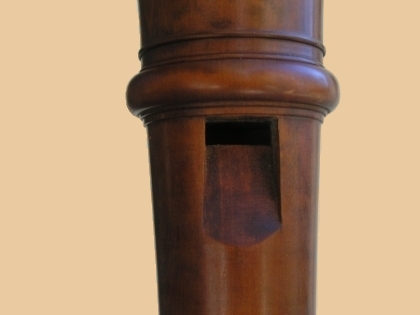
The recorder can be identified by 2 main characteristics found together:
- 1- A mouthpiece comprising a windway and a labium.
A block or fipple inserted in the top of the mouthpiece forms the "floor" of the windway.
- 2- Eight holes including an octave hole (thumb hole) on the back. On baroque type recorders he bottom two holes are often double for playing semitones.
On those without a removable foot the last hole is offset to the right for the little finger. There are sometimes two holes, one on either side, to enable playing with the left or right hand below, the unused one being filled with was.

The recorder has 8 holes (including the thumb hole). The bottom two are often double. It is a chromatic instrument. Because there is no key mechanism, nearly all the semitones are played with fork or cross fingerings..
The left hand is normally placed above the right hand on the instrument, but this has not always been the rule.
Most recorders, have a range of two and a half octaves. However renaissance consort recorders usually have a smaller range of less than two octaves.Les quatre tailles de flûte à bec les plus courantes aujourd'hui sont la soprano en do, l'alto en fa, la ténor en do et la basse en fa. L'alto est devenue la flûte à bec soliste par excellence.
How recorders work
A SHORT HISTORY OF THE RECORDER

The drawing of a recorder in Diderot & d'Alembert' Encyclopedia.
The origin of the recorder goes back to the Middle Ages. Few medieval recorders have survived, but one of the oldest known ones was found in the moat surrounding a castle built in the 14th century near Dordrecht, in the Netherlands.
The instrument has continually evolved over the centuries. During theRenaissance
it was mainly used for consort music and different sized recorders were made and played together.
From the 17th centuryonwards the recorder became a solo instrument. The soprano was the dominant recorder in Northern Europe, whereas the g alto continued to be used in Italy.
At the beginning of the Baroque period, the design of the recorder changed considerably, giving it a wider range and more virtuoso possiblities. From then on recorders were made in three pieces to make precise boring of more complex internal profiles easier.
IThere is an article on the recorder of this time in Diderot & d'Alembert's Encylopedia .
After the middle of the 18th century the instrument, which was not loud and dynamic enough to compete with the flute, fell into near oblivion for about 150 years. It therefore escaped the changes brought to wind instruments during the 19th century and was not equipped with a key system.
It is interesting to note that recorders continued to be made uninterruptedly from the 18th century to our time in a small town in Bavaria, Berchesgaden, in the form of the Berchtesgadner Fleitl a small soprano instrument in c or d, mainly used for local folk music.
Fipple flutes did not completely disappear during the romantic period, but survived in the form of theflageolet in France and in England, as well as the Czakan in eastern Europe, particularly in Austria and Hungary.
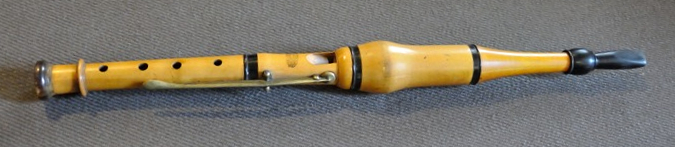
A French flageolet by Prudent Noblet (La Couture-Boussey, 19th century) with a piano or echo key.
The key on the flageolet above enables more expressive playing. When it is opened the player can blow more softly without loss of intonation. It is operated by the left hand little finger. This type of key can be seen on some modern recorders but it is not a recent invention.
The recorder was rediscovered towards the end of the 19th century and came back into fashion around 1960 with the revival of early music.
The design of recorders continues to evolve today. .

A tenor recorder after Stanesby Junior (London, 1692 - 1754), his "True Concert Flute"
THE RECORDER TODAY
The recorder is not only a historical instrument. It has also found a place of honour in contemporary music, and many composers of our time have written pieces for it.
School and study recorders are usually produced industrially, in plastic or in wood, whereas more specialised, top quality instruments are handmade in small workshops, using traditional methods.
Woodscommonly used for these instruments are boxwood and grenadilla for solo recorders, maple, pear and other fruit woods for consort recorders.
"Baroque" ou "English" fingerings are in common use on recorders made today. They are fairly close to the originals, even though they have undergone a few changes. Some copies of early instruments are tuned according to historical fingering charts. There is also a simplified diatonic system called "German" ou "modern" fingering which is not recommended nowadays because of intonation problems in certain keys.
In its different forms the recorder has a repertoire that covers more than seven centuries from the Middle Ages to the present day.
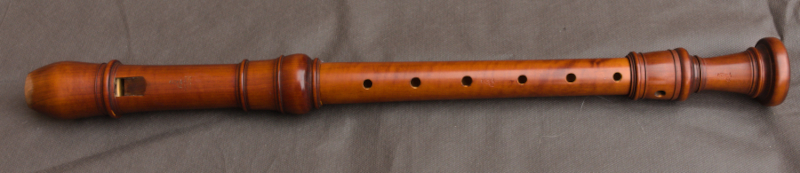
an alto (treble) recorder after Jean-Hyacinthe Rottenburgh (Brussels, 1672-1765)
Here are some other names for the reocrder:
Flûte à bec or flûte douce (in French), Blockflöte (in German), blokfluit (in Dutch), flauto de pico or flauto dulce (in Spanish), flauto dolce (in Italian), and flauta de bisel or flauta doce (in Portuguese). The modern term blockflute is also used in English nowadays as an alternative name, possible to avoid confusion with electronic recording devices.
This website is optimized for mobile and tablet devices.
Latest update: Pre-baroque (transitional) recorders, 11 september 2026