PHILIPPE BOLTON
HANDMADE RECORDERS & FLAGEOLETS
Maintenance operations
requiring removal of the recorder block
This page describes more serious maintenance operations inside the windway, such as cleaning the windway or removing fungus, that require the block to be
taken out of the recorder. This must be done with great care.
It is dangerous to poke any kind of tool into the windway without removing the block first.
How to remove and replace the block.
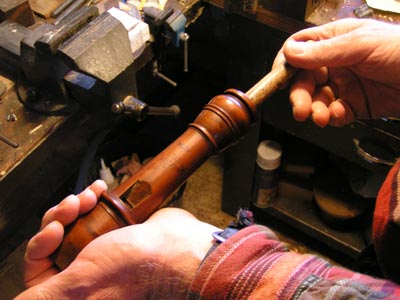
| Use a piece of wooden dowel whose diameter is slightly smaller than that of the instrument's bore. Check that its end is smooth so as not to mark the end of the block. Only do this when the recorder is dry, otherwise the block will be difficult to remove, having swollen with moisture, resulting in possible damage. If you do find the block impossible to move, don't continue but give the instrument to a competent repairer. |
|
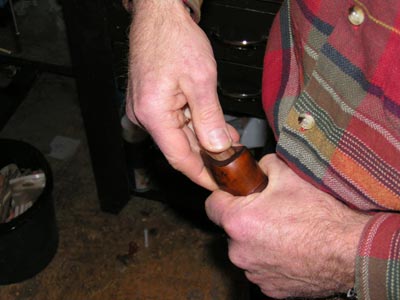
Put the dowel into the lower end of the bore and tap the block backwards. By putting a finger on the block you should feel it moving. Use the other hand to stop it from flying out violently and being damaged. You can also put a sock around the end of the head to catch it if necessary.
|
To replace the block insert it carefully into the instrument ensuring that it is exactly in
line with the windway and in the right place. If it came out easily, it will go in again easily.
Just push it in with your thumb, taking care not to break the end. If it resists you will have
to shave a little wood off the sides of the circular part. You can do this by scraping with a
sharp knife held almost vertically against the surface. The places to work on are visible,
since the wood has been compressed by contact with the inside of the recorder and appears somewhat shiny. Take care not to damage the top of the block that fits in the windway. |
How to hold the block
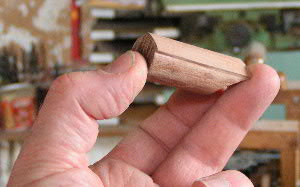
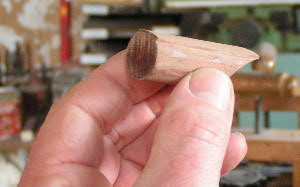
Avoid touching the top of the block, to keep it clean. Always hold it by both ends or by its sides as shown.
|
|
Cleaning the windway
For this you can use a cotton bud soaked with alcohol and a clean soft toothbrush. You can safely remove any accumulated dirt by rubbing the wood, using the toothbrush in the corners. Don't use any metal tools, which could leave marks and cause irreparable damage. Don't touch the chamfers either. This could modify the sound and speech of the recorder.
Treating fungus (aspergillus)
This is a serious problem, which must be treated without delay. It
can have a disastrous effect on the sound and cause damage to the wood in the long run. Maple and
box are more prone to this than some other woods. The block is often more resistant than the
instrument itself.
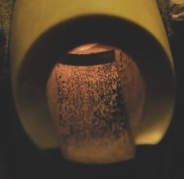
fungus in a recorder's windway |
If fungus is observed action should be taken quicky because damage could be caused in the long run to the underlying wood. Some species of aspergillus are a danger for health. A solution of thymol 3% in pure alcohol can also be used. This can be prepared by any local pharmacy. Thymol has antifungal and antibacterial properties and is effective against aspergillus. It is not soluble in water, so the product absorbed by the wood should continue to protect it for some time, since it cannot be eliminated quickly by condensation in the windway. |
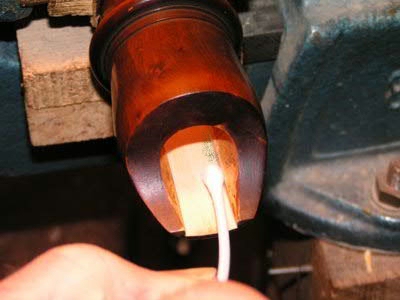
First remove the block (as shown at the top of this page). Then soak a cotton bud with this preparation
and rub the black spots in the windway, as shown in the picture above, until all the roughness has gone.
A clean toothbrush can be useful for getting into the corners. Don't use any metal tool that could scratch or damage the windway surfaces.
The windway must be checked regularly afterwards to be sure that the fungus does not reappear. If it does, just
repeat the treatment. It will finally go for good.
It is almost impossible to eliminate fungus in the windway without taking the block out of the instrument
because some rubbing is necessary to remove it completely, treat the wood and restore the smooth surface required for good sound quality.
To help prevent fungus from forming in the windway, be sure to let the instrument dry out always after playing before putting it in a closed case, and to store it in a dry place,away from any dampness.
 Thymol is also effective against fungi such as Penicillium, Alternaria, Ulocladium, Absidia, Mucor, Cladosporium, Trichoderma, Rhizopus et Claetomium.