PHILIPPE BOLTON
HANDMADE RECORDERS & FLAGEOLETS
TUNING ADJUSTMENTS ON THE RECORDER
This page explains techniques that can be used for simple tuning adjustments.
However this kind of work should only be undertaken by someone who knows what he is doing, otherwise it should be given to a specialist repairer.
Work on the recorder's holes
To modify the pitch of a note either the position of the appropriate hole or its diameter needs to be modified.
- A note that is too low can be tuned by moving the hole up the instrument (towards the windway) or by enlarging it.
- Inversely a note that is too high can be tuned by moving the hole down the instrument or by reducing its diameter.
The choice of one or other method depends on the note to be corrected, and on the other ones that depend on the same hole. Most of the holes of the recorder can influence the tuning of several notes, since there are only eight holes for a range of over two octaves.
- When a hole influences a note and its octave the position will have more influence on the lower note, while the diameter will have more influence on the upper note.
- When a hole influences both a simple fingering note and a fork fingering note the influence on the fork fingering will be quicker.
When retuning one particular note it is very important to watch the possible changes on all other notes depending on the same hole as shown in the table below.
How to modify a hole
To move a hole up or down the instrument, it is often sufficient to enlarge it on one side, and fill it in on the other side if necessary with a little beeswax. To increase its diameter without moving it just enlarge it all around.
|
The safest tool for enlarging holes is a coarse round file.A fine file is inefficient on wood. Work at an angle in order to undercut the hole rather than cut it vertically. Work calmly in a downward direction. Be careful to avoid the file "jumping" out and marking the instrument.
|
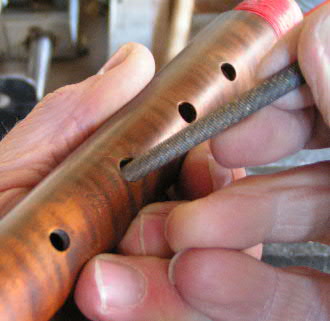
|
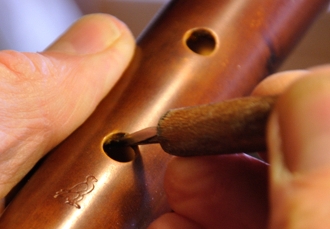
using the tuning knife |
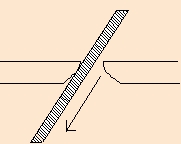
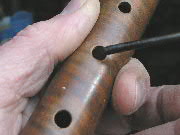
However, recorder makers usually use a narrow tuning knife, but this technique needs learning. A 3 mm double-bevelled blade is perfect for this. The top and bottom areas of the hole must be cut separately, beginning on one side and working around to the other, stopping before the blade gets parallel to the fibres, when it will start splitting the wood instead of cutting it. This circular movement is made easier with a round handle. |
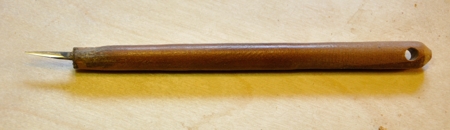
le canif à accorder |
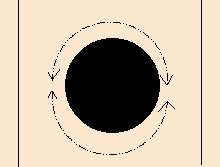
how to work around a hole |
Finish the job by cleaning the hole with small rolls of progressively finer grained abrasive paper (240, 320, 400).
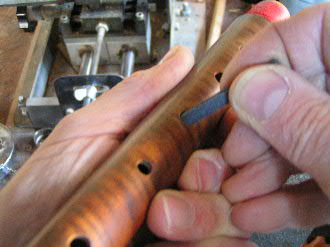
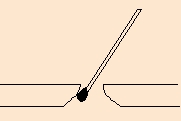
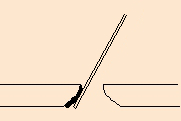
Wax can be used to reduce the size of a hole. Beeswax is suitable for this. This can be done with a small metal point like the handle of a needle file. Heat this on a flame, then touch the wax to melt it and pick up a drop which should quickly be placed it the right position inside the hole. It will harden on contacting the wood. Use the same tool to spread the wax along the undercutting.
1 |
2 |
|
How to place a drop of wax in a hole (1), and spread it inside the undercutting (2).
Practical examples :
- To raise a low note without changing its upper octave too much, open the top (windway) side of the hole. It may also be necessary to put some wax in the opposite (bell) side) to reduce its diameter.
- To lower a low note without changing its upper octave too much, put some wax in the top (windway) side of the hole. It may be also be necessary to open the opposite (bell) side).
- To raise a high note without changing its lower octave too much, open the bottom (bell) side of the hole. It may also be necessary to put some wax in the opposite (windway) side to reduce its diameter.
- To lower a high note without changing its lower octave too much, put some wax in the bottom (bell) side of the hole. It may also be necessary to open the opposite (windway) side).
Which hole to work on?
Holes are numbered from 0 (the thumb hole) to 8 (the bell).

The following instructions are for a baroque type alto or treble recorder in f. They must be interpreted for working on other recorders. The note names carry a number corresponding to the octave they are situated in. F1 is the lowest F, F2 is the middle F, F 3 is the highest F, and so on.
| Note to tune | Hole to work on |
Other notes influenced by the same hole (which must be checked) |
| F1 | 8 (pavillon) | Eb2, E2, F3 |
| F#1 | 7 (left double hole) | Eb2, E2, F3 |
| G1 | 7 | Eb2, E2, F3 |
| G#1 | 6 (left double hole) | A1, A2, E2, F3 |
| A1 | 6 | A2, E2, F3 |
| Bb1 | 5 | Bb2 |
| B1 | 4 | C1, B2, C2 |
| C1 | 4 | B1, C2, B2 |
| C#1 | 3 | C#2, D1, D2 |
| D1 | 3 | D2, C#1, C#2 |
| Eb1 | 2 | E1, F3 |
| E1 | 2 | Eb1, F3 |
| F2 | 1 | G2 |
| F#2 | 0 (south side) | G2 |
| G2 | 0 (north side) | F#2 |
| G#2 | 0, 7 |
F#2, G2 (0)
G1, Eb2, E2, F3 (7) |
| A2 | 6 | A1, E2, F3 |
| Bb2 | 5 | Bb1 |
| B2 | 4 | C1, B1, C2 |
| C2 | 4 | B1, C1, B2 |
| C#2 | 3 | C#1, D1, D2 |
| D2 | 3 | D1, C# 1, C#2 |
| Eb2 | 7, 8 |
G1, E2, F3 (7) F1, E2, F3 (8) |
| E2 | 6, 7, 8 |
A1, A2, F3 (6) G1, Eb2, F3 (7) F1, Eb2, F3 (8) |
| F 3 | 2, 6, 7, 8 |
E1 (2) A1, A2, E2 (6) G1, Eb2, E2 (7) F1, Eb2, E2 (8) |
Notes above F3 cannot be tuned easily.
Tuning adjustements via the bore

It is possible to adjust octaves by putting wax inside the bore.
A piece of wax positioned half way between the labium and the note's hole will reduce its octave relationship, while placing it close to the hole itself should enlarge it.
This does not work for Eb2, E2, F3 and G3, nor does it apply to F2, F#2 and G2, which are first register (fundamental) notes.
Place the wax in the right position, then apply a warm piece of metal to make it melt and adhere to the bore.
Octaves can be widened by placing wax in the bore where shown here:

1 = D 2=C 3=Bb 4=A
Octaves can be made smaller by placing wax in the bore where shown here:

1 = D 2=C 3=Bb 4=A
Eb2, E2, and F3 can sometimes be tuned up with wax at the top of the foot bore, but possible adverse effects on other notes should be checked.

 = the places where some wax can be placed to raise high Eb, E and F
The wax can be removed fairly easily, so mistakes can be rectified without too much difficulty. It is wise,however, to experiment beforehand with pieces of plasticine as there can be adverse effects on the tuning, speech or stability of other notes.