PHILIPPE BOLTON
HANDMADE RECORDERS & FLAGEOLETS
Wood for making recorders
|
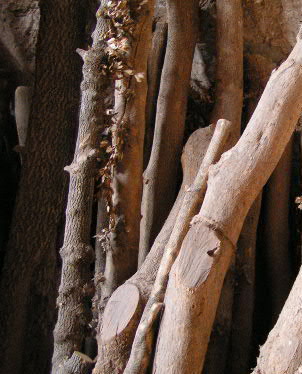
Boxwood is very hard and gives extremely smooth surfaces. For this is the reason it was widely used during the baroque era, because it could give a powerful and brilliant sound well suited to solo instruments. During the renaissance period recorders were often made from softer woods like maple and some fruit woods but boxwood was also common. Amongst the 43 renaissance recorders in the collection of the Kunsthistorisches Museum in Vienna at least 21 are made from boxwood, including 10 tenors and 3 bassets.
Ebony was the only tropical wood that was in common use during the baroque era. Because of its tendency to crack, the fragile parts were reinforced with ivory rings. Other tropical woods like palisander (rosewood) and grenadilla were introduced during the 19th century for making woodwind instruments. They are more stable than boxwood and less prone to cracking than ebony. |
To ensure maximum stability, the pieces of wood are air-dried for 10 to 20 years before being used.
There is an interesting audio document on boxwood (in French) at "Bonsbecs.fr"
(Once on the web site, select Alphabec, then Épisode 13 : B comme Buis)
Here are some woods commonly used for making recorders:
European woods
boxwood (natural)
|
boxwood (stained) |
maple
|
pearwood
|
cherry
|
Tropical Woods
ebony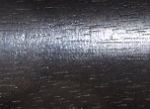
|
palisander (rosewood)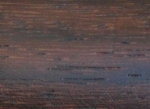
|
grenadilla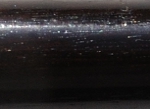
|
tulip wood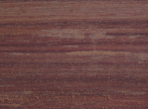
|
cocobolo
|
Many tropical woods are now protected. Some, like cocobolo, can cause allergic reactions.
Unlike metal or plastic, wood is living material. Its use for making such precise objects as musical instruments requires careful preparation, beginning with seasoning. When a tree is felled it is full of sap, which needs a fairly long time to disappear. The wood can only be used when this is over. During seasoning, tensions appear which usually result in deformation or cracking, after which it becomes more stable. This takes several years when done naturally, but the duration can vary with the thickness of each piece. Sawing logs into planks or squares can accelerate the process. As a rule of thumb one year is allowed per centimetre.
Old woodworkers used to cut their trees, in winter, when they are at rest, and in the last quarter of the moon, when its tidal effect attracts the remaining sap towards the roots. Trees cut then are less prone to rotting and attacks by insects and fungus. This observation was the result of many years' experience. Some modern instrument makers take this into account, and observe the best times for cutting.
Seasoning requires a cool, dry and shady place. Boxwood is often dried in logs, stacked vertically against the walls. Maple and fruitwoods are normally sawn into planks or squares which are laid down horizontally, separated by strips of dry wood to ensure good ventilation.
To reduce the risk of deformation the pieces are cut up so that the wood fibres are as close as possible along the length of the instrument. To ensure this, boxwood logs can be split rather than sawn.
The instrument blanks are left to rest for some time after having been turned into cylinders, and straightened again on the lathe if there has been any warping. After the initial boring they are again put aside to ensure maximum stability before being transformed into recorders.
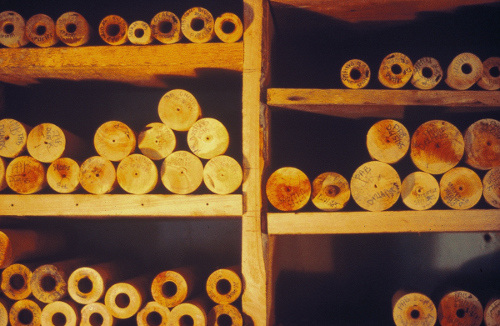
instrument blanks prepared in advance
|
When making the head joint the the wood's growth rings are generally set vertically. This reduces the risk of cracks near the windway, since these are more prone to happen across the rings, as shown in the drawing opposite.
Moisture absorption is also better this way, since condensation formed while blowing can penetrate between the fibres this way.
|
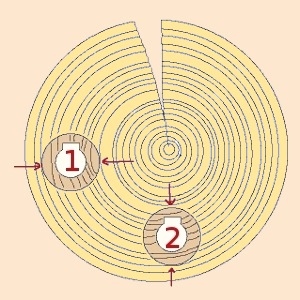 The red arrows show where the risk of cracking is greatest. |


|
Moisture absorbtion is also better when the growth rings are vertical, particularly on the block, because it can penetrate more easily between the wood fibres. |
When the block is wet it tends to expand, and could crack the head of the recorder. It is therefore normally made from a softer wood to prevent this from happening. Some resinous species, like juniper (often called "cedar") are particularly suitable since they are resistant to mildew, but deciduous wood blocks can be found in many antique recorders.