PHILIPPE BOLTON
FLUTES A BEC & FLAGEOLETS FAITS A LA MAIN
THE RECORDER'S AIR COLUMN: middle g
Here is a fork or cross fingering, with an open hole and two closed holes below it. This lengthens the vibrating air column
and makes the note sound a semi tone lower,
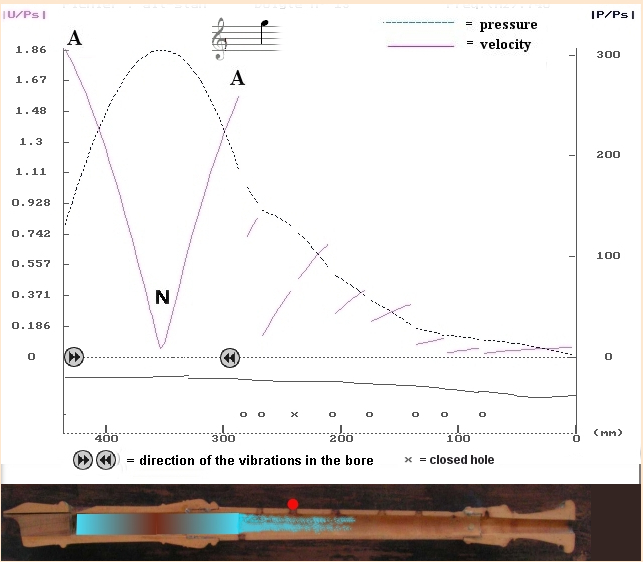
The following chart shows how the recorder's first register works.
Velocity antinodes (A) are low pressure zones with high speed or movement. Velocity nodes (N), on the contrary are high pressure zones with no
speed or movement.
Basically recorder air columns have an antinode at each end and a node in the middle. The 2 graphs show the pressure and velocity variations
within the instrument's bore.
Waves that travel along the bore of the instrument meet at the node and continue until they reach the opposite end of the tube where they bounce back,
and keep on moving up and down in this way as long as the player keeps blowing.
The chart shows the position of the nodes and antinodes. There is one graph for velocity and one for pressure variations along the air column.
The arrows show the direction of the vibrations.
The recorder's bore profile, and the open (o) and closed (x) holes are shown underneath.
Opening a hole could amount to cutting the air column at that point, but on recorders the holes are not big enough, so the air
pressure and velocity diminish gradually further down.
The nodes and antinodes described here are velocity nodes and antinodes.
 = closed hole;
This diagram is for a baroque alto or treble recorder.