PHILIPPE BOLTON
HANDMADE RECORDERS & FLAGEOLETS
The recorder's air column for fork fingerings
The following charts show the position of the nodes and antinodes in the recorder's air column. There is one graph for velocity and one for pressure variations along bore. The recorder's bore profile, and the open (o) and closed (x)holes are shown underneath.
|
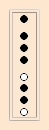
Recorders have small holes, enabling the use of fork (or cross) fingerings for playing most of the semitones.
In the diagrams below the bell-shaped graph shows the pressure variations inside the recorderand the v-shaped one shows the velocity variations. The top of the bore is on the left. x = closed hole 0 = open hole |
|
Normal fingerings
Opening a hole is theoretically equivalent to cutting off the vibrating air column at that point, but the recorder's holes are too small for that, so the velocity and pressure only diminish progressively beyond. This is why fork fingerings like the one on the right are possible.
Fork fingerings
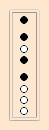
Fork fingerings consist in opening a hole closing one or two holes below it. Because the open hole is too small to "cut off" the vibrating air column, the pitch is lowered by a semitone. The note shown below is very different from the one on the left.
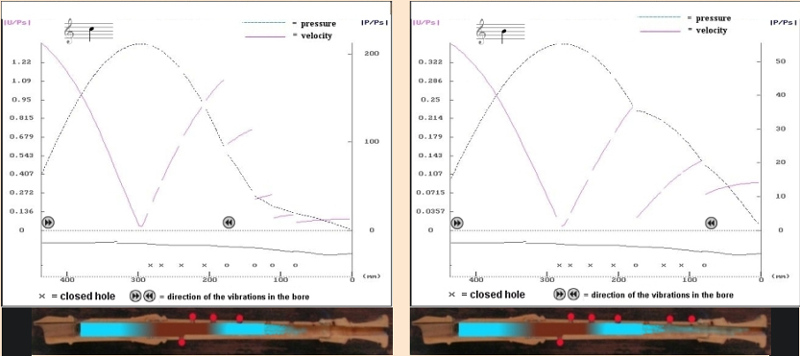
a normal fingerfing (left) a fork fingering (right)
 = closed hole These graphs & pictures are for a baroque alto or treble recorder

|
If the holes were much larger, fork fingerings would not be possible. |

|
If we could enlarge the holes to almost the same diameter as the bore, we would obtain much higher notes, but they would also effectively cut the air column when open, so nothing could happen lower down any more.
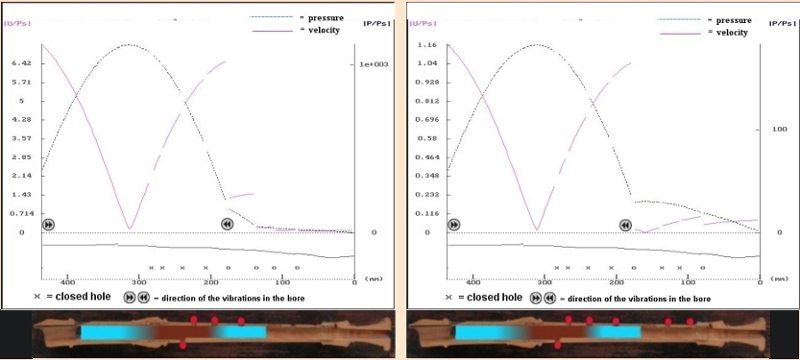 a normal fingerfing with a large hole (left) a fork fingering with a large hole (right)
= closed hole These graphs & pictures are for a baroque alto or treble recorder
Fork fingerings have almost no effect with large holes, and closing
holes below an open one hardly changes the frequency of the
note being played. So the note shown below is very similar to the one on the left, and completely different from the one above